Starting a Business in Australia, Step by Step
Plenty of people want to start their own business and get stuck on the same question: where do I even begin? Especially if you already have a job and are thinking of building something on the side, without giving up the security of a pay cheque.
The good news is that starting in Australia is simpler than most people expect. There are only a few steps, most are online, and several are free. This article summarises that path: what to do, in what order, and where to be careful.
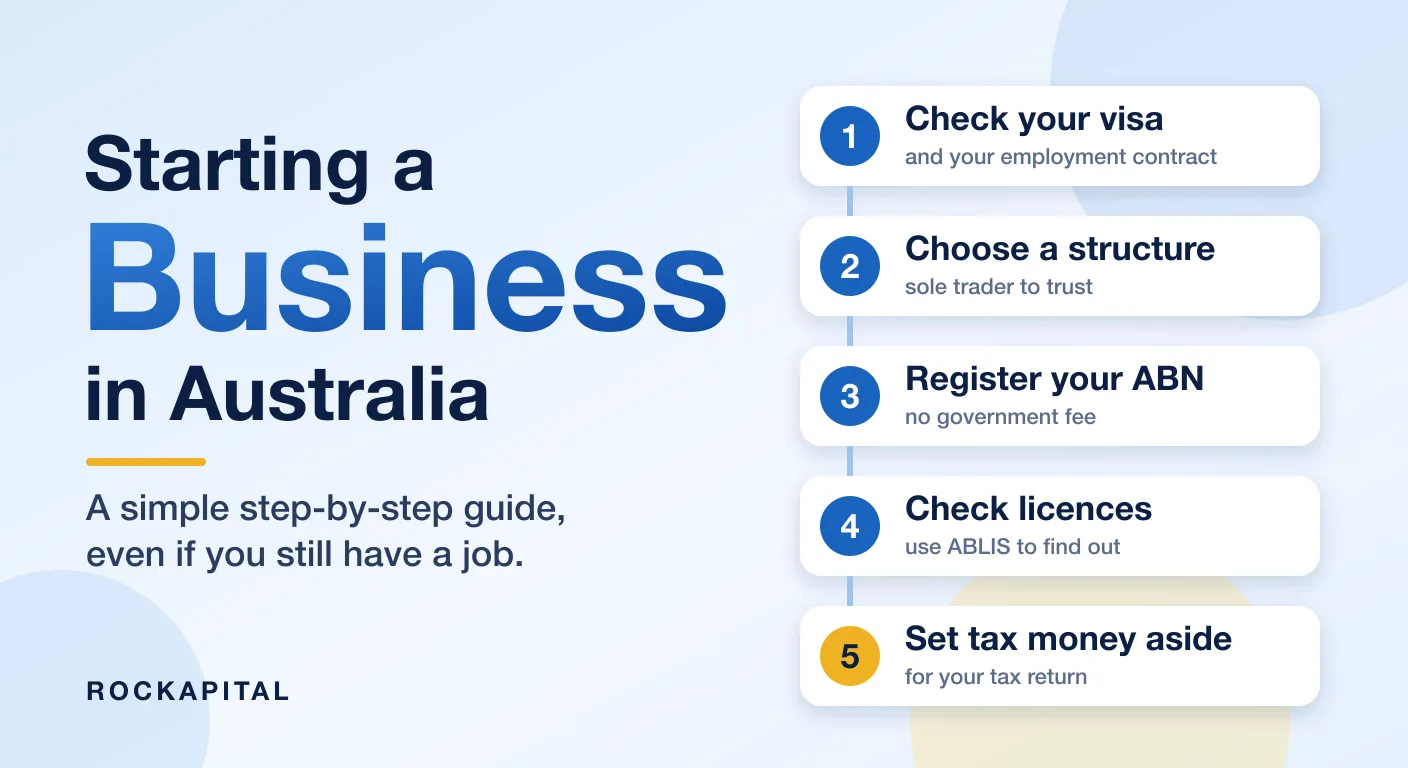
1. Check your visa
First, check the conditions of your visa. Some limit the type of work or the hours, and not all allow self-employment. If that applies to you, sort it out first.
2. If you have a job, read your employment contract
Starting a business alongside your job is often possible, but read your employment contract first. Some employers have exclusivity or conflict of interest clauses, or require you to tell them about other work. This matters even more if your business is in the same field as your job.
Once that is clear, you can start small. For example, Marina works as an analyst during the week and starts selling cakes to order on weekends. She only decides whether to grow after seeing how her first customers respond.
3. Choose a business structure
There are several possible structures, and each suits a different situation:
- Sole trader: the simplest. You and the business are the same legal person. E.g. Marina selling cakes on her own.
- Partnership: when two or more people run the business together. E.g. two friends opening a barbershop.
- Company (Pty Ltd): a separate legal entity, with more rules and more flexibility. E.g. an IT consultancy planning to hire a team.
- Trust: a more sophisticated structure, common for families and for asset planning. E.g. a family running a business and a few investment properties together.
There is no single right structure for everyone. The choice depends on your situation, your project and where you want it to go, and you can start one way and change later. To understand the difference between the two most common options, see Sole Trader vs Company in AustraliaSole Trader vs Company in Australia: Which Pays Less Tax?Compare structures, tax treatment, and long-term business considerations.Read more →.
4. Register your ABN
An ABN (Australian Business Number) identifies your business. You use it on invoices and when dealing with clients and suppliers. You apply on the Australian Business Register (ABR) website, and the government does not charge a fee for the ABN.
If you want to trade under a name other than your own, you can also register a business name with ASIC. For example, Carlos Silva, an electrician, could trade as "Silva Electrical" instead of his own name. If you use your own name, registration is optional.
If you would rather have help with the ABN application and choosing a structure, that is a service Rockapital offers.
5. Check whether you need GST
GST is the 10% tax on most goods and services. Registration is compulsory once your turnover reaches $75,000 a year, or you expect it to. For example, a designer earning $6,500 a month reaches $78,000 over 12 months and needs to register. Below the threshold it is optional, with some exceptions (such as ride share and taxi drivers). We have a full guide: Do I Need to Register for GST in Australia?Do I Need to Register for GST in Australia?Learn when registration is required and how to comply.Read more →.
6. Check whether your activity needs a licence
Many people find this out too late. Depending on your activity, on top of an ABN and other registrations there may be specific licences and registrations you need before taking on clients. A few examples:
- Building, renovations, electrical and plumbing (Carlos, from the example above, cannot work as an electrician without the relevant licence)
- Food businesses (to sell cakes regularly, Marina may need approval from her local council)
- Transport and ride share
- Health and other regulated fields
- Child care, beauty and other regulated services
Rules vary by state and industry. Before investing time and money, find out what your activity requires. ABLIS (the Australian Business Licence and Information Service), run by the Australian Government, helps with this: you answer a few questions about your activity and location, and it shows the licences, regulations and approvals that may apply. You can find it at ablis.business.gov.au.
7. Get the basics organised from day one
A few simple habits save a lot of headaches later:
- Open a separate bank account for the business.
- Keep invoices, receipts and statements. The ATO requires records to be kept for 5 years.
- Consider accounting software such as Xero, MYOB or QuickBooks.
- Think about insurance that suits your activity.
8. Set money aside for your tax return
This is one of the most important points for anyone moving from employment (with a TFN) to running a business with an ABN. As an employee, your employer withholds tax and pays it to the ATO, so the money that lands in your account is already after tax. With an ABN, nobody withholds tax for you: the full amount arrives, and the tax is only paid with your tax return at the end of the financial year.
That means part of what lands in your account is not really yours. For example, Marina receives $1,000 for an order. The full amount reaches her account, but part of it will become tax on her tax return. If she spends it all, she may get an unpleasant surprise at year end.
The safest habit is to move a percentage of every payment into a separate account. To know how much to set aside in your case, talk to an accountant. If you are registered for GST, remember too that the 10% you charge clients belongs to the ATO, not to your business. In some cases the ATO may also ask for tax in advance during the year.
Quick checklist
- Confirm your visa allows it
- Read your employment contract, if you have a job
- Choose a structure (sole trader, partnership, company or trust)
- Register your ABN
- Decide on a business name and GST
- Check licences specific to your activity on ABLIS
- Open a bank account and organise your records
- Set aside part of every payment for your tax return
It can be simpler than it looks
Starting a business does not have to be a leap in the dark. Many people begin small, alongside their job, and adjust the path as the project grows. What matters most is starting with the right foundations: a suitable structure, the right registrations, any licences your activity needs and tax money set aside.
If you are at the planning stage and want to talk through the first steps, Rockapital can help. We work in English and Portuguese, 100% online.
Use the contact form below to ask a question.
This article is general information only. It does not consider your personal circumstances and is not a substitute for professional advice. Information verified 03/10/2026; rules, thresholds and fees can change.Ready to get your accounting sorted?
Rockapital helps small businesses with bookkeeping, BAS, GST registration guidance and tax compliance support across Australia.
You Might Also Like
Explore more tax and business topics
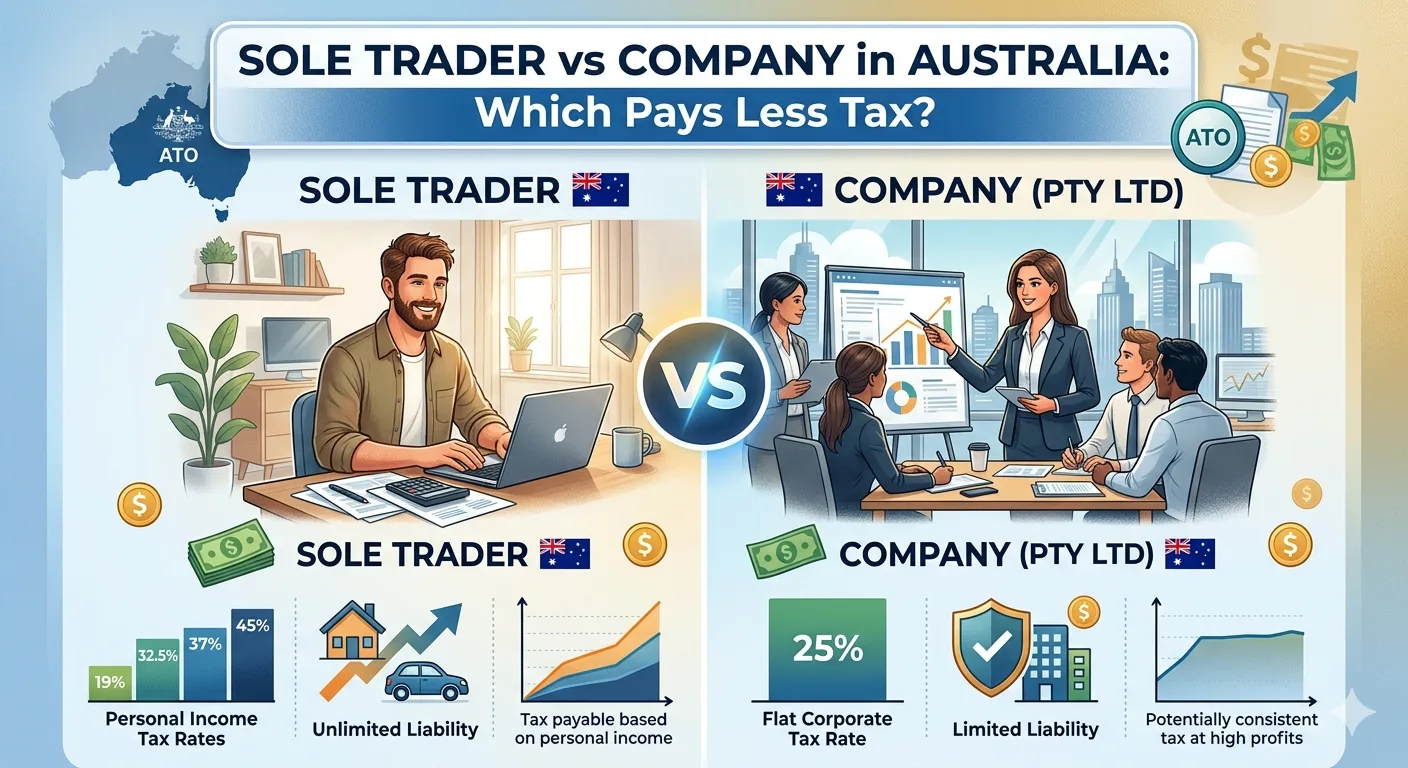
Sole Trader vs Company in Australia: Which Pays Less Tax?
Compare sole trader and company tax treatment and see which structure may be more tax efficient.
Read article →
Do I Need to Register for GST in Australia?
Understand the $75,000 threshold, registration timing, and GST compliance requirements.
Read article →