Do I Need to Register for GST in Australia?
If you run a business in Australia, one of the most important tax questions you need to answer is whether you must register for GST.
Getting this wrong can create cash flow problems, incorrect invoices, missed GST credits, penalties, and unexpected tax debt.
The answer depends mainly on your GST turnover, your type of business, and whether any special rules apply to you.
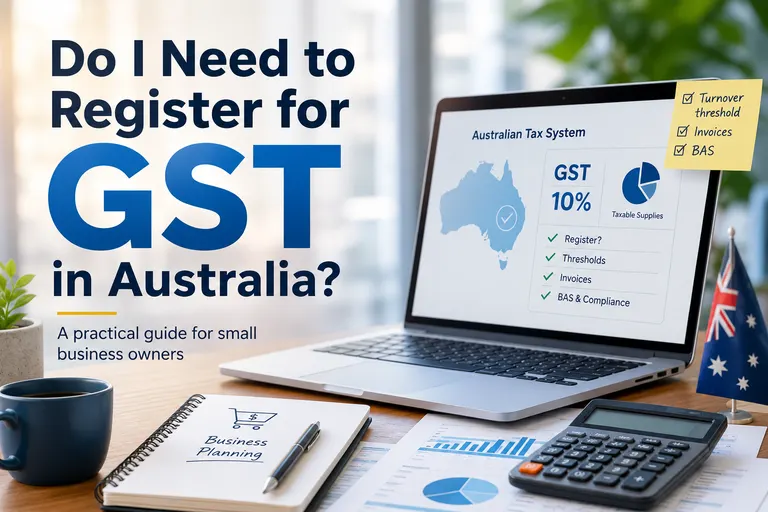
What Is GST?
GST stands for Goods and Services Tax.
It is a 10% tax that applies to most goods, services and other items sold or consumed in Australia.
If your business is registered for GST, you generally need to:
- Add GST to the price of taxable sales
- Issue tax invoices when required
- Report GST through your Business Activity Statement (BAS)
- Pay GST collected to the ATO
- Claim GST credits on eligible business purchases
GST is not your business profit. It is money collected from customers and later reported to the ATO, after offsetting eligible GST credits.
When Do You Need to Register for GST?
You must register for GST if any of the following applies:
- Your business has a GST turnover of $75,000 or more.
- Your non-profit organisation has a GST turnover of $150,000 or more.
- You provide taxi or ride share services, regardless of turnover.
- You want to claim fuel tax credits for your business.
For most small businesses, the key threshold is $75,000.
GST Turnover Means Revenue, Not Profit
A common mistake is thinking the $75,000 threshold is based on profit.
It is not.
GST turnover is based on business income, before expenses.
For example, if your business earns $80,000 in sales but only makes $35,000 in profit after expenses, you may still need to register for GST because your turnover is above the threshold.
This is one of the most important points for sole traders, contractors and small business owners to understand.
Current and Projected GST Turnover
You should monitor your GST turnover regularly.
You may need to register if your current or projected turnover reaches the threshold.
This means you should not wait until the end of the financial year to check.
If your business is growing and you expect your turnover to reach $75,000 over a 12-month period, you should review your GST position early.
Once you become aware that your GST turnover will go over the threshold, you generally need to register within 21 days.
What Happens If You Register for GST?
Once registered, your business must generally charge GST on taxable sales.
This means that if you charge $110 for a taxable service, $10 is GST.
That GST is not extra profit. It is reported to the ATO through your BAS.
At the same time, you may be able to claim GST credits on eligible business purchases.
For example, if you buy business equipment for $1,100 including GST, the GST component is $100. If the purchase is eligible and you hold the correct evidence, you may be able to claim that $100 as a GST credit.
What If You Are Not Registered for GST?
If you are not registered for GST, you should not charge GST on your invoices.
You also should not issue tax invoices.
Instead, you issue standard invoices and make clear that GST has not been charged.
You also cannot claim GST credits on your business expensesWhat Expenses Can Sole Traders Claim in Australia?Learn which business expenses may be deductible and why records matter.Read more →.
For example, if you buy equipment for $1,100 including GST and you are not registered for GST, you generally cannot claim the $100 GST component as a GST credit.
Should You Register Voluntarily If You Are Below $75,000?
If your turnover is below $75,000 and no special rule applies, GST registration is usually optional.
Voluntary registration may be useful in some situations, especially where:
- Most of your customers are GST-registered businesses
- You have significant start-up costs
- You want to claim GST credits on business purchases
- You want your business to appear more established
- You expect to exceed the threshold soon
However, voluntary registration also creates extra obligations.
You may need to lodge BAS, maintain better GST records, issue tax invoices correctly, and manage GST cash flow.
For businesses selling mostly to private consumers, voluntary registration can also affect pricing. If your customers cannot claim GST credits, adding GST may make your prices look more expensive unless you absorb the GST within your existing price.
The Pricing Trap Many Small Businesses Miss
GST registration can affect your pricing more than you expect.
Suppose you currently charge $1,000 for a service and you are not registered for GST.
After registering, you need to decide whether your price becomes:
- $1,100 including GST, meaning the customer pays more; or
- $1,000 including GST, meaning you effectively keep only $909.09 before GST.
This is a major cash flow and profitability issue.
Many businesses reach the GST threshold but fail to adjust their pricing early enough. As a result, they end up paying GST out of their own margin.
If your business is approaching $75,000 turnover, review your pricing before you are required to register.
Taxi, Ride Share and Similar Services
Special rules apply to taxi and ride share services.
If you provide these services, you may need to register for GST regardless of your turnover.
This can apply even if the activity is part-time.
Drivers using platforms such as Uber or DiDi should be particularly careful, as the normal $75,000 threshold may not apply in the same way.
GST-Free and Input-Taxed Sales
Not every sale has GST added to it.
Some sales may be GST-free, such as certain basic foods, medical services, health services and education courses.
Other sales may be input-taxed, such as certain financial supplies and residential rent.
These categories can affect whether GST is charged and whether GST credits can be claimed.
If your business operates in food, health, education, property, finance, exports or overseas transactions, you should get advice before assuming GST applies in the normal way.
Overseas Businesses Selling to Australian Customers
GST can also apply to some overseas businesses that sell to Australian consumers.
This may include imported services, digital products and low-value imported goods.
If an overseas business sells to Australian customers and meets the relevant GST turnover threshold, Australian GST registration may be required.
This area has specific rules and should be reviewed carefully.
What If You Register Late?
If you should have registered for GST but did not, the ATO may require you to backdate your registration.
This can create a serious problem.
You may have to pay GST on past sales even if you did not charge GST to your customers at the time.
For example, if you charged clients $55,000 after you should have been registered, the ATO may treat part of that amount as GST collected.
This means the GST may come out of your own pocket.
This is why monitoring turnover is so important.
Common GST Mistakes
Small businesses often make the following mistakes:
- Waiting until tax time to check GST turnover
- Thinking GST is based on profit instead of revenue
- Charging GST before being registered
- Failing to charge GST after registration
- Issuing tax invoices while not registered
- Forgetting to update prices after registering
- Claiming GST credits without valid evidence
- Mixing personal and business expenses
- Treating all sales the same, even when GST-free or input-taxed rules may apply
- Not setting aside GST collected from customers
Most GST problems are avoidable with proper setup and regular bookkeeping.
Simple GST Checklist
You should review your GST position if:
- Your business income is approaching $75,000
- You expect strong growth in the next 12 months
- You provide ride share or taxi services
- You want to claim fuel tax credits
- You sell food, health, education, property or financial services
- You sell digital products or services to Australian consumers from overseas
- You are unsure whether your invoices are correct
- You have not lodged BAS correctly
- You have changed business structureSole Trader vs Company in Australia: Which Pays Less Tax?Compare structures, tax treatment, and long-term business considerations.Read more →
- You recently moved from sole trader to company
Final Thoughts
GST registration is not just an administrative step.
It affects your pricing, cash flow, invoices, bookkeeping and compliance obligations.
For many small businesses, the best approach is to plan before reaching the $75,000 threshold rather than reacting after the business has already crossed it.
If you are unsure whether you need to register for GST, or if your business is approaching the threshold, getting advice early can help you avoid costly mistakes.
Rockapital helps small businesses with bookkeeping, BAS, GST registration guidance and tax compliance support across Australia.
Contact us to review your GST position before it becomes a problem.
Ready to sort your GST registration? Let us help.
Rockapital helps small businesses with bookkeeping, BAS, GST registration guidance and tax compliance support across Australia.
You Might Also Like
Explore more tax and business topics

What Expenses Can Sole Traders Claim in Australia?
Learn which business expenses are deductible and how to maximise your tax deductions.
Read article →
Sole Trader vs Company in Australia: Which Pays Less Tax?
Compare sole trader and company tax treatment and see which structure may be more tax efficient.
Read article →